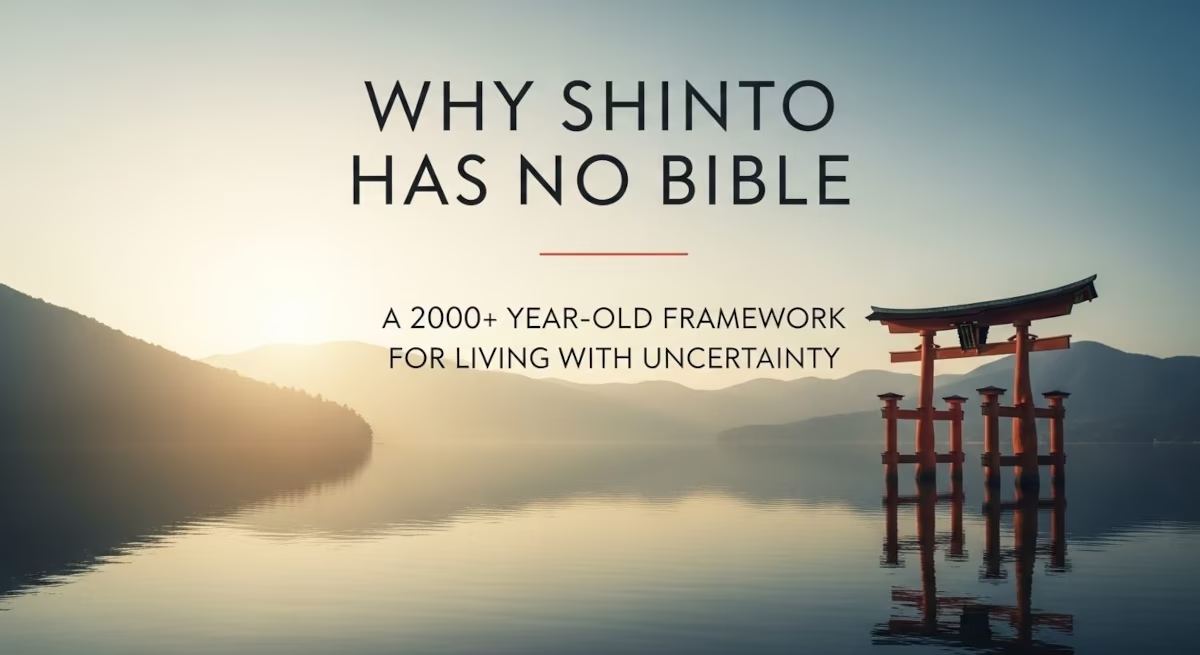
Why Shinto Has No Bible: A 2,000+ Year-Old Framework for Living with Uncertainty
You can't control your way out of modern life
Your calendar controls when you wake up. Algorithms control what you see. Market forces control your salary. Corporate policies control your time. Legal systems control your options.
You've been told to "take control of your life." Set goals. Optimize your routine. Manage your emotions. Track your habits.
But here's the uncomfortable truth: most of your life is beyond your control.
And the more you try to wrestle control from systems bigger than you, the more exhausted you become.
What if there was a different approach? Not about gaining control, but about making peace with its absence?
What Shinto actually is (and isn't)
When Westerners hear "Shinto," they think:
- Nature worship
- Shrine tourism
- Cherry blossoms and temple bells
- Maybe some anime references
But here's what Shinto actually developed as: a practical philosophy for living with forces beyond human control.
Ancient Japan had no illusion of control. Nature was unpredictable. Harvests failed. Earthquakes struck. Communities survived only by acknowledging what they couldn't change and working with those forces, not against them.
So Shinto became a set of practices — not beliefs — for relating to the uncontrollable:
- No single god (because reality isn't controlled by one force)
- No commandments (because rules don't work on chaos)
- No scripture (because abstract theology doesn't help when the typhoon comes)
Just rituals. Small gestures. Ways to acknowledge, respect, and emotionally process what you can't change.
"Eight million gods" (八百万の神) doesn't mean polytheism. It means: the world is complex, interdependent, and beyond any one person's comprehension.
Sound familiar? Welcome to modern life.
The science of letting go
Here's where ancient wisdom meets modern research.
For the past two decades, psychologists like Dacher Keltner and Jonathan Haidt have been studying awe — that feeling you get when confronting something vast and beyond your understanding.
What they found: awe reduces anxiety and rumination, makes people feel less self-focused, and even alters our perception of time — making it feel more abundant.
When you stop trying to comprehend and control everything, your nervous system relaxes.
Shinto rituals — bowing to a shrine, clapping twice, rinsing your hands — aren't about worship. They're structured moments of awe. Reminders that you're small, the world is vast, and that's okay.
The gesture itself does the work. Not the belief behind it.
Why modern self-care apps miss the point
We've built an entire industry around "taking control":
- Productivity apps say: Control your time better.
- Meditation apps say: Control your mind better.
- Journaling apps say: Control your narrative better.
But what happens when:
- Your company gets acquired and your job disappears?
- A loved one gets sick?
- The economy shifts and your savings evaporate?
- Life just… doesn't go according to plan?
All that "control" becomes an illusion. And when it shatters, you're left with guilt: "I should have planned better. I should have been more disciplined."
Shinto never promised control. It promised something else: a way to stay grounded when everything shifts.
One line is enough
This is why I built Kamidana App.
Not as a "Shinto app." Not even as a religious tool. But as a translation of that ancient framework into the smallest possible ritual:
- One line to let go.
- One line to move forward.
That's it.
No journaling pressure. No meditation timer. No productivity guilt.
Just a tiny gesture — typing one sentence — that acknowledges:
"This is beyond my control, and I'm releasing it."
"This is what I hope for, knowing I can't force it."
The app has a shrine aesthetic because shrines were always containers for these moments. Places to pause, acknowledge the bigger forces, and return to life a little lighter.
Users don't "pray to" anything. They practice acknowledgment. Of uncertainty. Of limits. Of being human in systems they didn't design.
What this means for you
You don't need to become Shinto. You don't need to believe in gods (eight million or otherwise).
But you might benefit from asking:
What am I trying to control that I actually can't?
Your boss's opinion? The algorithm? The economy? Other people's choices? The future?
And then:
What would change if I stopped fighting that, and just… acknowledged it?
Shinto doesn't promise control.
It offers something better: a way to stay sane inside systems you didn't design.
Capitalism. Bureaucracy. Algorithms. Power structures.
You can't opt out. But you don't have to let them consume you.
Try it
If this resonates, you can try the practice:
- Think of one thing that's been weighing on you
- Write one line acknowledging you can't control it
- Write one line about what you hope for anyway
That's the whole ritual.
If not: a piece of paper works just as well. The medium doesn't matter. The gesture does.
This essay is part of an ongoing exploration of how ancient practices can inform modern mental health. For more on the philosophy behind Kamidana App, visit kamidana.app/journal